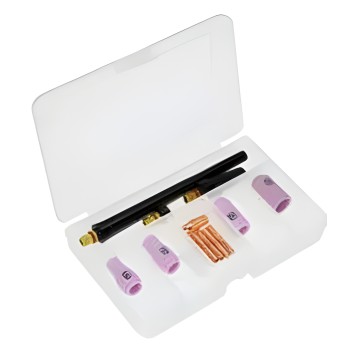
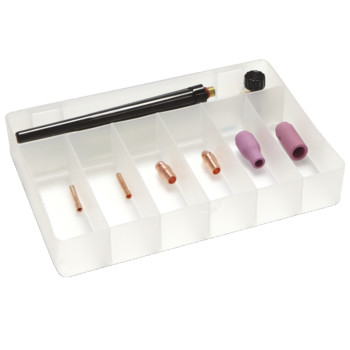
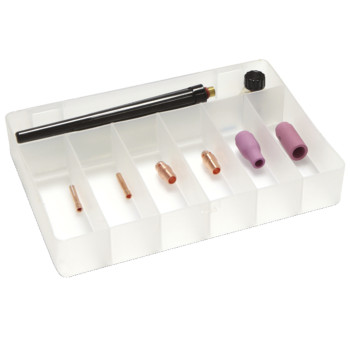
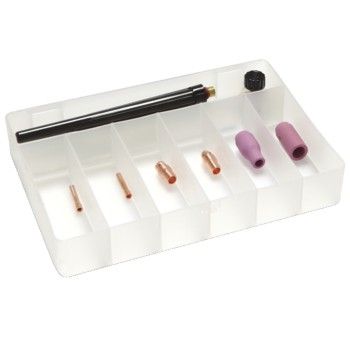
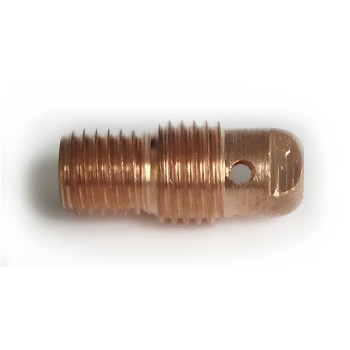
TIG welding can be used to produce high-quality, clean welds on most materials, such as steel, stainless steel, aluminium, nickel alloys, magnesium, copper, brass, bronze and gold. The TIG torch plays a major role, as it fulfils several key functions in the TIG process. In the process, a tungsten electrode is used to melt the metal, while argon-based shielding gas protects the weld pool from the ambient air. The TIG torch serves both as an electrode holder and as an electrical supply for the welding arc, while also conveying the shielding gas. For a torch to perform well, it is essential that the parts and accessories that make it up are also of high quality and well suited to the intended use.
In our selection, you will find everything you need to keep your TIG welding torch running properly, whether it is air-cooled or water-cooled. Nozzles, electrode holder collets, diffusers, back caps, various seals… you will find here parts and accessories for TIG torches, all of impeccable quality. Although you may purchase a TIG torch and its accessories solely for the needs of a specific application, your personal preferences should also be taken into consideration. For this reason, we offer you the best products available, and we are always entirely at your disposal for any questions and requests for further information.
The TIG torch and its components
The welding torch is the essential tool for ensuring the proper operation of the entire TIG welding circuit. TIG torch models are available air-cooled or water-cooled, depending on welding requirements. As a general rule, the TIG torch is divided into two distinct parts: the hose assembly and the handle.
The TIG torch hose assembly
The hose assembly is a neoprene protective sheath for user comfort, enclosing:
- the electrical cable
- the shielding gas supply hose
- the on/off control cable for the electrical circuit
- the two coolant circulation hoses for water-cooled torches.
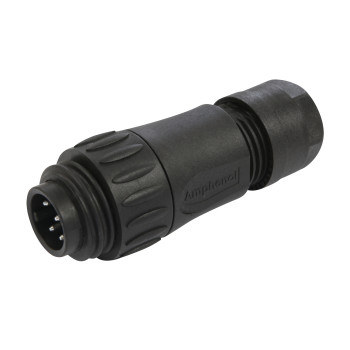
At the other end of the hose assembly are the connectors, fittings and pin for connections to the welding machine. For machines with the EU standard connector and the welding current connection pin, there are two types: 10/25 mm² and 30/50 mm². Some machines have complex connectors that enable functions beyond simple on/off, for example to allow the connection of a dual-control torch to manage two different amperage levels, a thumb-wheel torch to adjust amperage variation during welding, a foot pedal control, etc.
The TIG torch handle
The handle often has a pistol-grip shape. Universal models have handles designed to suit the widest possible range of users. The manual on/off control button — with a metal leaf switch or a contact switch — is fitted on the handle; it triggers the high-frequency arc start and controls the gas solenoid valve. The torch handle, a key component of welding, is heavily used, which is why its interchangeable parts should be managed with a considered supply approach.
At the front of the handle, you can distinguish:
- the nozzle
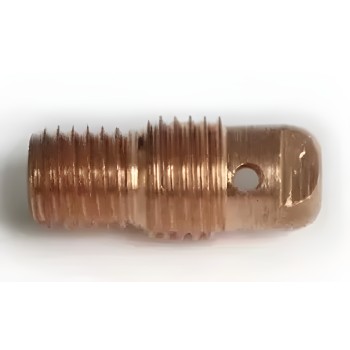
- the hole-type or grid-type gas diffuser
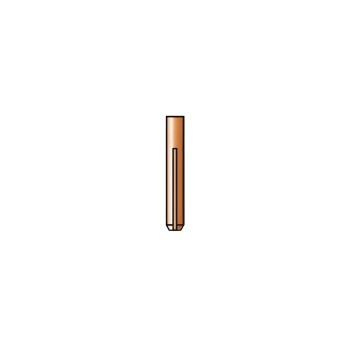
- the electrode holder collet
- the PTFE (Teflon) sealing ring.
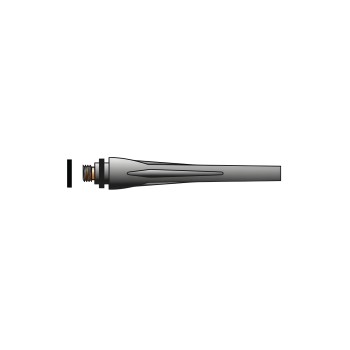
The back cap, also known as the plug, cap, hat or clamping cover, is located at the rear of the handle, screwed onto the top.
The TIG torch accepts the tungsten electrode; its diameter depends on the thickness to be welded, and its composition corresponds to the type of metal to be welded. The various components of the torch are therefore calibrated according to the tungsten electrode diameter, hence the need to have the appropriate wear parts readily at hand.
For demanding welders, there are sophisticated torches fitted with ball-joint handles, angled handles, adjustable handles… there is also the foot pedal option for welds performed in a seated position. Increasingly popular, foot pedals allow the operator to control amperage directly with the foot, freeing up wrist dexterity.
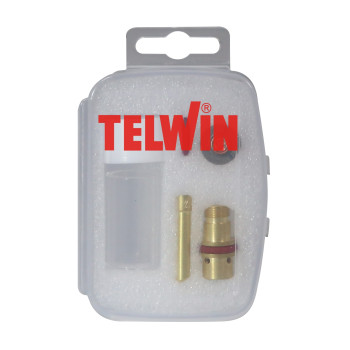
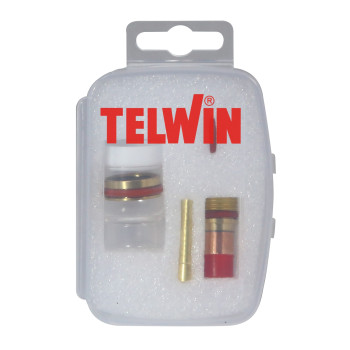
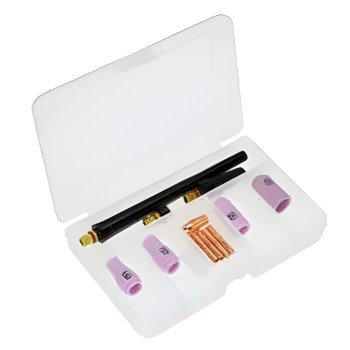
The most commonly interchangeable accessories
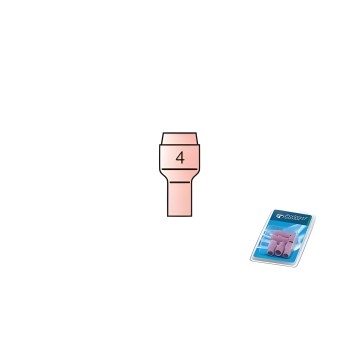
The TIG welding torch nozzle
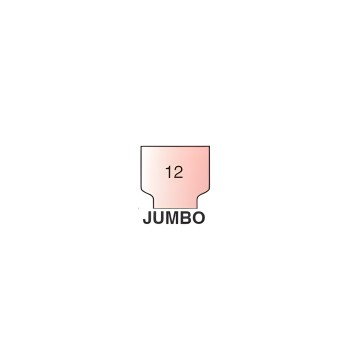
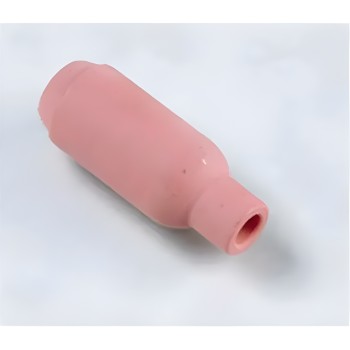
Nozzles used in TIG welding are most commonly made of ceramic (dark pink) for high performance, but they can also be made of aluminium (light pink) or corundum (white). Their diameter can range from 6 mm to 20 mm depending on the welding intensity.
Nozzles used in TIG welding are refractory; they can be opaque or transparent. The internal shape of the nozzle and the respective positions of the electrode and the nozzle must allow for non-turbulent gas flow. Some nozzles are fitted with an internal diffuser.
The nozzle is interchangeable and is also selected based on the thickness of the parts to be welded as well as the welding method. Depending on the welding technique used, the size and capacity of the nozzle differ. For flat welding, a general guideline is 100 l/h per mm of workpiece thickness, while for vertical welding, 50 to 80 l/h per mm of thickness is considered appropriate.
The choice of nozzle is anything but a minor detail, and in certain applications can have a decisive effect on the appearance and quality of the weld. That said, all systems (machines, hose assemblies, torches) are systematically supplied fitted with a standard diffuser and nozzle. The function of these components is to form, around the weld pool as well as behind the metal re-solidification zone, a volume free of oxygen in order to prevent the formation of oxides under the effect of high temperature. This phenomenon is more or less significant depending on the assembly application, the materials to be joined, and the requirements in terms of appearance. Standard-type nozzles therefore represent the ideal compromise for everyday use and on aluminium alloys.
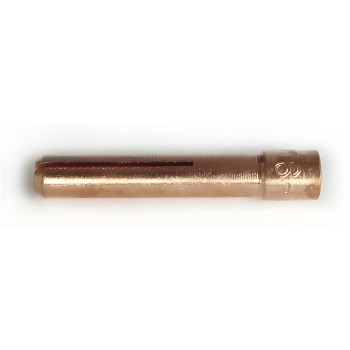
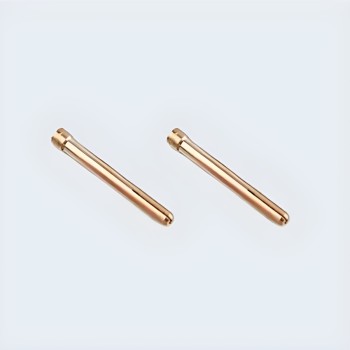
The electrode holder collet
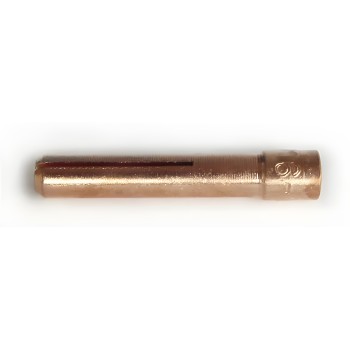
The electrode holder collet is available depending on the welding torch and offered in different lengths and diameters, ranging from 1 mm to 3.2 mm.
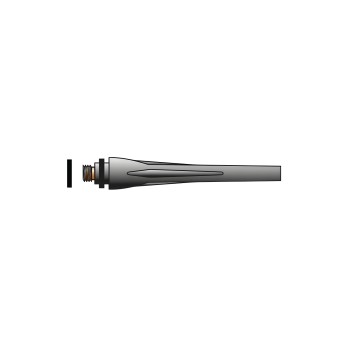
The TIG torch back cap
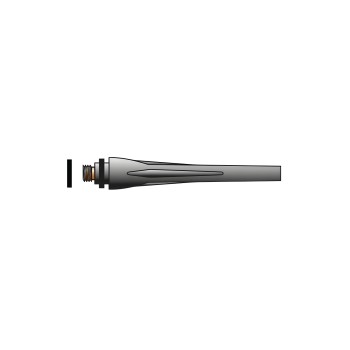
The torch back cap or protective head comes in three models: short, particularly useful for welds to be carried out in confined spaces; medium; and long, for normal use — it can accommodate a full-length tungsten electrode.
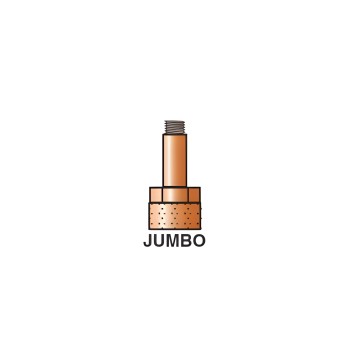
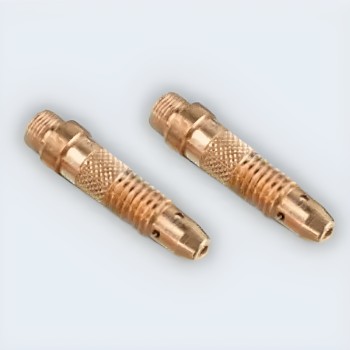
Hole-type gas diffuser and grid-type gas diffuser
The distribution of shielding gas with a grid-type diffuser is far better than with a hole-type diffuser. There is no turbulence or disruption of the gas flow within the inerting cone when using a grid-type diffuser. The tungsten electrode can protrude more than 10 mm beyond the nozzle without any risk of contamination from ambient air.
However, the use of a grid-type diffuser makes it possible to reduce the gas flow rate by a good third without any issue, allowing for significant savings; the extra cost of the grid-type diffuser is more than offset by the gas savings.
Our experts' advice for assembling a TIG torch
Assembling the components of a TIG torch must be done step by step, as there is a risk that the torch will not function correctly, or worse, that incorrect assembly can cause irreversible damage.
Generally, you start by assembling on one side the gas diffuser (hole-type or grid-type) and the nozzle made of refractory material (alumina or other), and on the other side the seal (PTFE) on the torch handle. The diffuser is screwed onto the nozzle, then the other end of the diffuser is screwed onto the handle body.
The electrode is threaded into the collet, and the assembly is inserted from the rear of the torch. Make sure the electrode holder collet is oriented correctly — the shoulder must face rearward, otherwise it will partially block the diffuser, preventing the gas from flowing at the correct rate, and the electrode will also be poorly centred.
All that remains is to screw on the clamping cap so as to apply reasonable pressure on the collet and thus secure the electrode in place. The clamping force does not affect the seal, thanks to the presence of a gasket.
It should be noted that the electrode holder collet corresponds to only one specific electrode diameter. If you use several electrode diameters, you will need several corresponding collets. Additionally, the electrode can also be inserted from the front once the back cap has been loosened.
The following diagram summarises these steps.
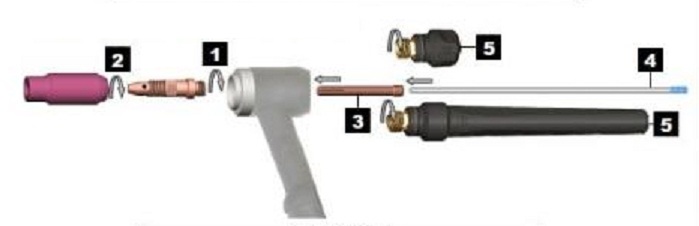
1 – diffuser
2 – nozzle
3 – electrode holder collet
4 – electrode
5 – back cap (here: short and long)


 Italy
Italy
 Germany
 Netherlands
 Croatia
 Denmark
 Finland
 Greece
 Ireland
 Portugal
 Sweden
 Norway
 Bulgaria
 Estonia
 Latvia
 Lithuania
 Poland
 Czech Republic
 Romania
 Slovakia
 Slovenia
 Hungary



 2-year warranty