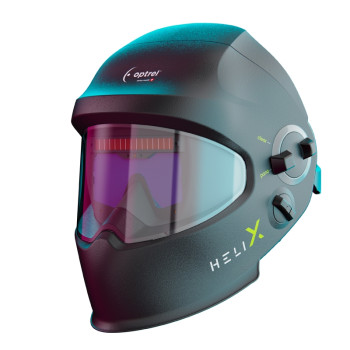
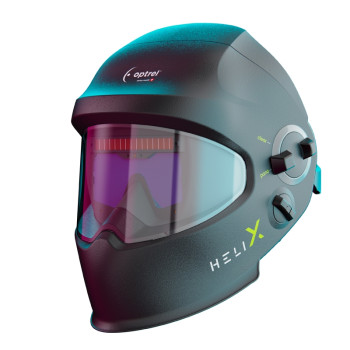
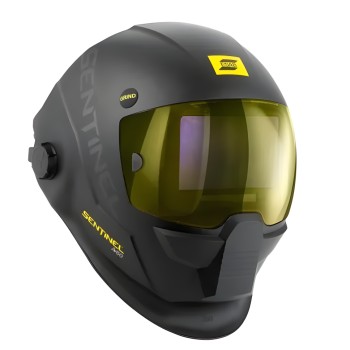
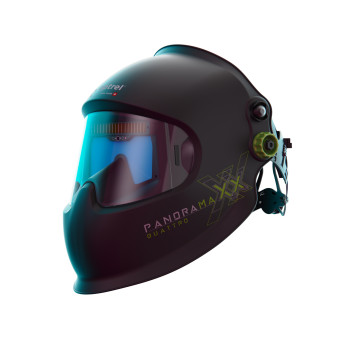
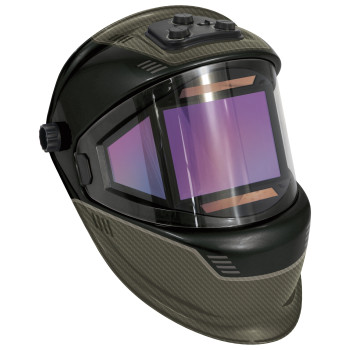
As a welder, it is essential to practice your profession while taking care to protect your wellbeing. For this purpose, various protective accessories are recommended. Some are common across different crafts (gloves, safety glasses, etc.), while others such as welding masks are specific to welders. These accessories are very useful in welding practice, particularly to protect the eyes from sparks produced by the various welding processes. While the oldest versions of welding masks were handheld, today the situation is very different. There are dozens of variations, and the one that has been creating a buzz for some time is the panoramic welding helmet.
What is a panoramic welding helmet?
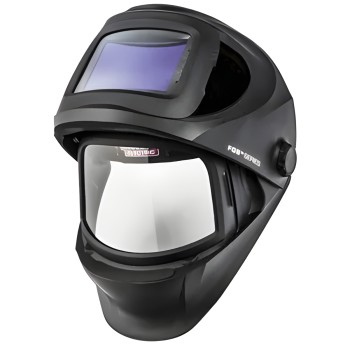
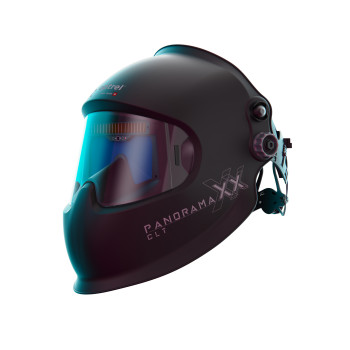
A mask or welding helmet is the protective equipment used in welding practice to shield the welder's eyes from UV and infrared rays. It also prevents metal splatter from reaching the face. Furthermore, panoramic welding helmets have some distinctive features. As implied by the name of this accessory, it offers a 180° panoramic view. The welder can thus carry out their various welding tasks without having to remove the mask to see laterally.
The advantages of the panoramic welding helmet
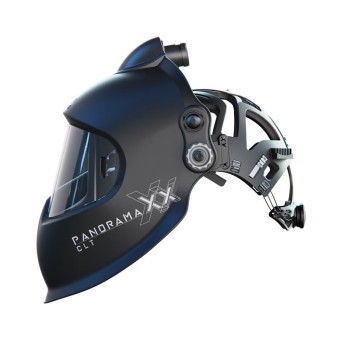
The wide field of vision provided by the welding helmet comes from its three windows, two of which are positioned on either side (left and right). The operator thus benefits from increased visibility thanks to a 180° field of vision. It is also worth noting that this type of mask features a headband that keeps the accessory in place and leaves the hands free.
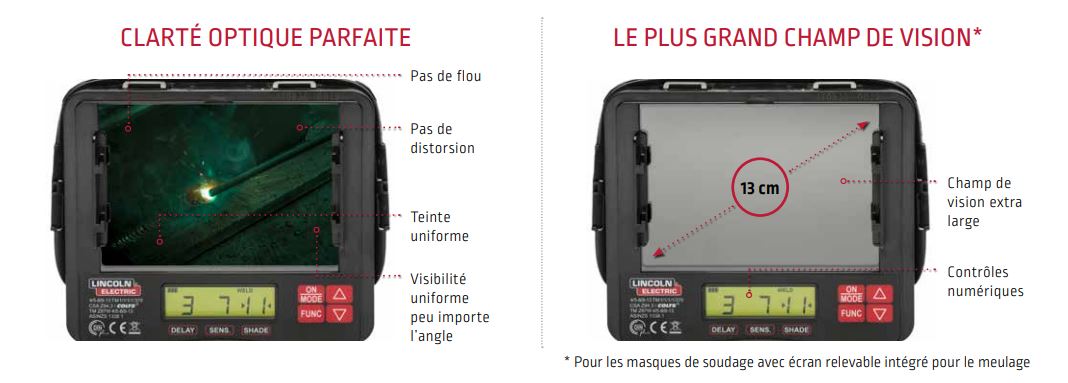
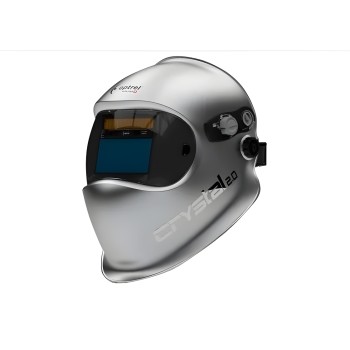
Beyond this aspect, this welding helmet is equipped with technology that makes it automatic. This automation is based primarily on liquid crystal filters that darken instantly when the welding arc appears. When the arc stops, however, the mask lens becomes transparent again. This feature is not merely cosmetic, as it eliminates the cumbersome gesture of lifting and lowering the mask visor at every moment. This is made possible by an electro-optical device that electronically evaluates the light threshold the eyes can tolerate.
With its unique ergonomics, the panoramic welding mask is practical and offers great comfort of use to the operator. A key example: the sensitivity of the liquid crystal filter can be adjusted according to the welding process. Depending on the brightness of the piece, it is possible to externally adjust the delay time for the transition from the dark state to the clear state after the arc stops.
The different parts of a panoramic welding helmet
The panoramic welding helmet uses innovative elements to provide greater protection for the welder's face and eyes. Regarding eye protection, it is common practice to have masks with at least two layers of glass — one on the outside and one on the inside. The inner layer is generally a grinding visor onto which a removable section closes, with the field of vision in the center and a glass layer equipped with a liquid filter (filter lens). Thus, depending on the type of welding, the filter lens changes color. On top of this, there are 4 arc sensors whose role is to measure the intensity of the light produced by the welding arc in order to determine when to darken the visor of the welding helmet. Just near the sensors, there is a solar power source combined with lithium. Of course, a panoramic mask means peripheral vision — this is the defining feature of this welding protection mask model.
Some panoramic helmets are two-in-one accessories, as they also include respiratory protection. The usefulness of this option stems from the fact that welders face a 40% higher risk of lung cancer compared to other sectors. As a result, there are numerous mask variations to address this issue, including the powered air-purifying welding helmet and the ventilated panoramic helmet.
Selection criteria for a 180° welding mask
First and foremost, criterion no. 1 for choosing a panoramic helmet is certification. Indeed, a 180° helmet should genuinely be 180°. For this, the presence of peripheral visors is of course required. Beyond this point, the helmet must be examined to verify that it meets the standards. If a mask is not compliant, do not buy it. Also examine, before purchasing a panoramic helmet, the cell darkening speed as well as its arc sensitivity.
Please note that on certain panoramic mask models, the settings related to shade control or the grinding function may be internal. On others, however, these options are external. It is up to you to find the one that suits you. The next criterion to consider is the number of arc sensors. It is based on the condition of these sensors that the function which darkens or clears the helmet is operational or not. Therefore, the higher the number of sensors, the greater the chance that the regulation function will not fail.
Regarding the power supply of the accessory, you have three choices to make. You can opt either for a mask with a lithium battery (which can be replaced), or for a model powered solely by solar energy (equipped with a non-rechargeable backup battery). You can also opt for a mixed power supply. This power supply combines both lithium battery operation and solar energy operation.
Regarding external criteria, pay attention to the dimensions and weight of the welding helmet. There is no standard size or weight to determine a good mask. You therefore need to try it on to determine whether or not it suits you. At the same time, other criteria — secondary but important — should be examined. These include checking whether your helmet has an on/off selector as well as an anti-sweat band.
With these various criteria in mind, you are equipped as a professional or novice to determine the appropriate panoramic welding mask for your various tasks.
Why use a helmet for protection?
In order to weld two metals together, a high temperature is required. At a certain level, this temperature produces intense light. Thus, when welding is carried out without any protection, the intense light of the welding arc can cause irreversible damage to the operator's eyes. The face, meanwhile, could be exposed to potential splashes of molten metal.
Given these many risks, the obvious solution is the welding mask. It will protect you not only from visible radiation, but also from invisible radiation such as infrared and UV rays. The welding helmet will also protect you externally from skin burns and visible eye injuries.
To conclude this overview, please note that the welding mask is also useful for protecting the welder from the various fumes, vapors and gases produced by the different materials being worked on.
The difference from welding goggles
It is well established that both welding goggles and welding masks provide essential eye protection. However, goggles lose their effectiveness as light intensity increases. At that point, only welding masks can counter the effects of radiation. Unlike goggles, which only protect the eyes, welding helmets protect the entire face and extend down to the neck.
Traditional welding masks
Traditional welding helmets are those long used by professional welders of a certain era. Some still prefer it with its fixed-shade glass lens. This type of helmet has a permanently dark tint. Less expensive and more durable than panoramic welding masks, classic masks have several shortcomings. These shortcomings have been somewhat addressed in panoramic models.
Among these drawbacks, one is the cumbersome nature of the accessory for the welder whenever they want a clear view of the weld and the joint being made. They must also raise the visor each time they wish to begin welding or prepare their welding position. They are then forced to lower the visor each time they want to strike the arc. In addition to this frequent inconvenience, this movement can cause neck tension as well as significant fatigue at the end of the day.
This repetitive motion is even more frequent among novice welders whose technique is not yet fully developed. This will force them to frequently raise and lower their helmet to check whether the torch is properly positioned in the joint for striking. If the striking phase fails, the weld will be marred by welding defects, something no welder wants.


 Italy
Italy
 Germany
 Netherlands
 Croatia
 Denmark
 Finland
 Greece
 Ireland
 Portugal
 Sweden
 Norway
 Bulgaria
 Estonia
 Latvia
 Lithuania
 Poland
 Czech Republic
 Romania
 Slovakia
 Slovenia
 Hungary



 2-year warranty