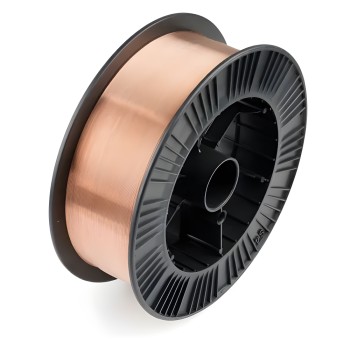
The Corten steel welding wire is the MIG consumable designed for joining self-patinating steel by semi-automatic welding. Like the Corten rod, the Corten wire allows the weld bead to develop the same patina as the base metal. Discover our selection of Corten wire spools.
Why use a wire specific to Corten?
Corten steel develops a protective rusty patina on its surface. A Corten steel wire of suitable composition allows the weld bead to patinate in the same way as the rest of the structure, making the assembly almost invisible over time. An ordinary steel wire would produce a bead that would not patinate uniformly, which would be detrimental to the aesthetics of visible structures.
Solid or flux-cored Corten wire?
The solid Corten wire is used in MIG-MAG with an argon-CO₂ shielding gas. The flux-cored Corten wire can be used without gas, which is practical outdoors. Solid wire produces a cleaner bead; flux-cored wire leaves slag to be removed. The choice depends on gas availability and welding conditions.
Diameter and compatibility
The diameter of the Corten wire spool is chosen according to the material thickness and the machine's amperage. Check compatibility with your drive rolls, your contact tip and your MIG torch. Common diameters (0.8, 1.0, 1.2 mm) cover most work on this metal.
Corten in MIG welding
The MIG-MAG machine offers good productivity on Corten, ideal for medium to large structures (cladding, planters, furniture). The settings are similar to those for structural steel: work on offcuts to adjust voltage and wire speed. The Corten welding wire produces a regular bead that patinates naturally.
Patina uniformity
As with the rod, the key challenge of Corten welding wire is patina uniformity. A bead produced with the right wire gradually develops the same colour as the surrounding metal through cycles of moisture, over time. This is the condition for a successful finish on architectural and decorative Corten structures.
Corten and MIG-MAG: the right configuration
To weld Corten by MIG, set up your machine as you would for structural steel: argon-CO₂ gas, contact tip of the correct diameter, suitable drive rolls and voltage adjusted on offcuts. The only particular feature is the Corten wire itself, whose composition ensures patina uniformity. The rest of the welding circuit is standard, which makes implementation straightforward for any welder experienced in MIG-MAG.
Complementarity with the Corten rod
The MIG Corten welding wire and the MMA Corten rod meet different needs. The MIG wire is more productive and suitable for long beads and large workpieces (cladding, structures). The MMA rod is more portable and suited to small repairs and difficult-to-reach areas. Having both allows you to cover all situations encountered on self-patinating steel structures.
Storing Corten wire
Like any welding wire, Corten wire must be kept dry, in its packaging, away from moisture. An oxidised or damp wire produces a porous and irregular bead. Install the spool correctly on the wire feeder and check the brake tension to avoid jams and tangles. A properly stored Corten welding wire retains its qualities and produces a bead that will patinate uniformly.
The importance of aesthetics in Corten
Since Corten steel is often chosen for its appearance, the quality of the weld bead is doubly important: it is both structural and aesthetic. A quality Corten welding wire, well welded and well finished, produces an assembly that will visually blend into the whole after a few weeks of natural patination. It is this combination of strength and appearance that makes Corten so valuable for architectural and decorative projects.
Finally, consider combining the MIG Corten wire and the MMA Corten rod in your stock to cover all situations, from productive workshop use to on-site work.
Our recommendation
To weld Corten steel by MIG, choose a Corten wire of suitable composition, either solid with gas or flux-cored for outdoor use. Check compatibility with your equipment and allow the patina to develop naturally. Browse our selection of Corten steel wire spools.
Frequently asked questions
Why use a specific welding wire for Corten steel?
Its composition allows the weld bead to develop the same protective rusty patina as the base metal, for a uniform finish. An ordinary wire would produce a bead that would not patinate in the same way, which is visible on exposed structures.
Solid or flux-cored Corten wire?
Solid wire is used with argon-CO₂ gas for a cleaner bead. Flux-cored wire can be used without gas, which is practical outdoors, but leaves slag to be removed. The choice depends on gas availability and welding conditions.
Does the Corten bead become invisible?
With the right wire, the bead progressively develops the same rusty colour as the surrounding metal, making the weld almost invisible over time. This is the main challenge of Corten welding for architectural and decorative structures.
What diameter of Corten wire should I choose?
Depending on the material thickness and the machine's amperage: common diameters are 0.8, 1.0 and 1.2 mm. Check compatibility with your drive rolls, contact tip and MIG torch.


 Italy
Italy
 Germany
 Netherlands
 Croatia
 Denmark
 Finland
 Greece
 Ireland
 Portugal
 Sweden
 Norway
 Bulgaria
 Estonia
 Latvia
 Lithuania
 Poland
 Czech Republic
 Romania
 Slovakia
 Slovenia
 Hungary



 2-year warranty